 Solution Bowl
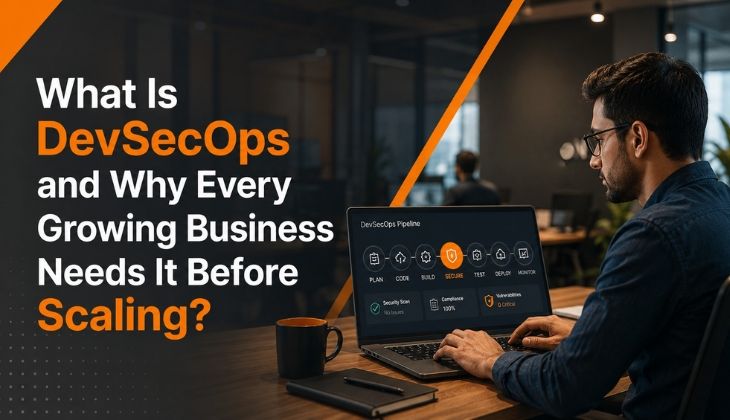
What Is DevSecOps and Why Every Growing Business Needs It Before Scaling?
If you have ever launched a product, fixed a security issue after launch, and wondered why no one caught it earlier, you have already experienced the problem that DevSecOps solves.
For most growing businesses in India, security is still an afterthought. Development teams build fast. Deployment happens. And then somewhere down the line, a vulnerability surfaces in a live app, in a payment flow, or in a customer data pipeline. By that point, the cost of fixing it is not just financial. It is reputational.
DevSecOps is the approach that changes that sequence entirely. And if you are planning to scale your tech infrastructure in 2026, understanding it is no longer optional.
Planning to scale your software infrastructure this year? Talk to the SolutionBowl team about building security in from the start. Get in touch
What DevSecOps Actually Means
DevSecOps stands for Development, Security, and Operations. It is a software development philosophy that integrates security practices directly into the CI/CD (continuous integration and continuous delivery) pipeline, rather than treating security as a final checkpoint before release.
In a traditional model, security teams review code after it has been built. In a DevSecOps model, security checks run at every stage: during code commits, during builds, during testing, and during deployment. The idea is called "shift left security": move security checks earlier in the process, so problems are caught when they are cheap to fix, not after they are already in production.
The result is faster development cycles, fewer vulnerabilities in live systems, and a culture where every developer, not just the security team, takes ownership of secure code.
DevOps vs DevSecOps: What Is the Difference?
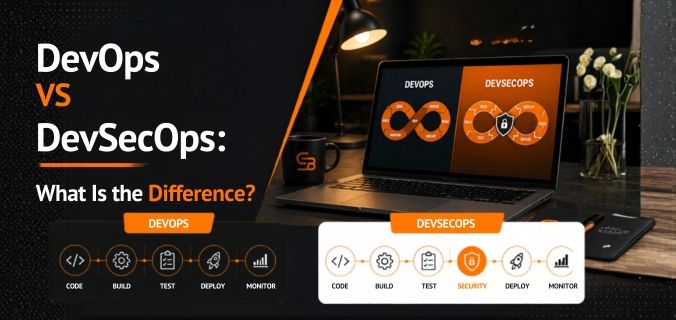
DevOps was already a significant shift from traditional software delivery. It broke down the wall between development and operations teams, enabling faster releases and better collaboration. Most growing tech companies in India have either adopted DevOps or are moving toward it.
DevSecOps takes that same philosophy one step further. Where DevOps integrated operations into the development cycle, DevSecOps integrates security into that same cycle. The difference is not just additive. It is structural.
| Security role | Separate review stage | Embedded throughout |
|---|---|---|
| When vulnerabilities are found | Post-build or post-deployment | During development |
| Who owns security | Security team | Entire development team |
| Release speed | Fast | Fast with built-in safety |
| Cost of fixing issues | High (found late) | Low (found early) |
A business running DevOps without security integration is essentially building fast on an untested foundation. DevSecOps does not slow that pace. It makes it sustainable.
"Scaling without securing is just scaling your risk. The companies we see struggle most after growth are those that treated security as something to add later. DevSecOps makes security the foundation, not the final floor."
Why Indian Businesses Are Particularly Exposed
India's startup and SME ecosystem has grown at a pace that infrastructure security has not always kept up with. A few realities that make this especially relevant right now:
Regulatory pressure is increasing.
DPDP (Digital Personal Data Protection) Act compliance is moving from awareness to enforcement. Businesses that collect, store, or process customer data, which is nearly every tech product, now face legal obligations around data security. A DevSecOps approach directly supports DPDP readiness by building privacy controls and audit trails into the development process itself.
Third-party integrations multiply risk.
Most Indian SaaS products, ecommerce platforms, and fintech apps rely on APIs from Razorpay, GST-linked systems, WhatsApp Business API, and Aadhaar verification services. For businesses running ERP systems, these API surfaces are even wider, with procurement, finance, and inventory modules all connecting to external platforms. Each integration is a potential attack surface. Without automated security checks in the pipeline, these surfaces go unreviewed until something breaks.
Talent gaps create blind spots.
Many growing companies in Delhi NCR, Bengaluru, and Hyderabad have strong development teams but no dedicated security engineers. DevSecOps tools and automation can partially bridge that gap by building security checks into the pipeline itself, reducing reliance on a single security specialist.
Cost of breaches is rising.
IBM's 2024 Cost of a Data Breach Report estimated the average cost of a breach in India at over Rs 19 crore. For SMEs and Series A startups, that is not recoverable. Proactive security investment through DevSecOps costs a fraction of that.
What DevSecOps Implementation Looks Like in Practice
DevSecOps is not a single tool you install. It is a set of practices and integrations woven across your development workflow. Here is what that typically involves for a growing business:
Static Application Security Testing (SAST):
Code is scanned for vulnerabilities as it is being written, before it is even built. This catches issues like injection flaws, insecure functions, and hardcoded credentials early in the process.
Dynamic Application Security Testing (DAST):
Running tests simulate real attacks against a working version of the application. This finds runtime vulnerabilities that static analysis cannot see, such as authentication bypasses or exposed API endpoints.
Software Composition Analysis (SCA):
Most applications today are built on open-source components and third-party libraries. SCA tools scan those dependencies for known CVEs (Common Vulnerabilities and Exposures) and flag risky packages before they reach production.
Container Security and Kubernetes Hardening:
For businesses running microservices on Kubernetes, each container image is a potential entry point. DevSecOps includes scanning container images for vulnerabilities, enforcing security policies across clusters, and managing access controls at the orchestration level.
Secrets Management:
API keys, database credentials, and tokens should never live in code repositories. DevSecOps pipelines include automated scanning for exposed secrets and integrate with tools like HashiCorp Vault or AWS Secrets Manager to manage them safely.
VAPT Integration:
Vulnerability Assessment and Penetration Testing (VAPT) is a standard requirement for enterprises, especially those in BFSI, healthcare, and government contracting. In a mature DevSecOps setup, VAPT findings feed directly back into the development pipeline rather than sitting in a report that no one acts on.
DevSecOps Best Practices for Teams Getting Started
If your organisation is earlier in this journey, these principles help build the right foundation without overwhelming your team.
Start with the pipeline, not the people. Before trying to change how developers think about security, automate the checks that run without anyone needing to remember. Integrating a SAST tool into your existing CI/CD pipeline is the right first step. It creates immediate value with minimal culture change.
Build security into your definition of done. A feature is not complete when it works. It is complete when it passes security checks. This shift in how teams define task completion is one of the highest-leverage changes a development manager can make.
Use role-based access controls from day one. Access sprawl is one of the most common causes of internal and external breaches. Define who can deploy, who can access production databases, and who can modify pipeline configurations, then review those permissions regularly.
Log everything, review regularly. Security incidents rarely announce themselves. Centralised logging and regular audit reviews allow teams to catch anomalies before they escalate. Tools like ELK Stack, Datadog, or CloudWatch make this manageable even for smaller teams.
Run threat modelling sessions before major features. Before building a new payment flow or user authentication system, spend an hour with developers and a security-aware lead asking: what could go wrong here? This does not require a dedicated security team. It requires a structured habit.
Application Security Automation: Where AI Is Changing the Game
In 2025 and into 2026, AI has begun to meaningfully accelerate DevSecOps workflows. Large language models are now being used to:
- Triage vulnerability alerts and reduce false positives
- Generate remediation suggestions alongside detected code flaws
- Analyse commit patterns to flag anomalous changes that may indicate a compromised developer account
- Assist in writing security test cases for new features
For Indian businesses that do not have the budget for a large internal security team, AI-assisted application security automation is becoming a practical path to enterprise-grade protection at SME-level cost. This is a category worth paying close attention to as tooling matures through 2026.
When Should a Growing Business Start Taking DevSecOps Seriously?
The honest answer is: before you scale, not after.
The logic is straightforward. Every developer-hour spent fixing a security issue post-launch costs five to ten times more than catching it during development. Every customer data incident your product is responsible for costs multiples more, in breach costs, in regulatory exposure, and in the trust that takes years to rebuild.
For most businesses, the trigger points are:
- You are handling payment data, personal health data, or Aadhaar-linked information
- You are integrating with government APIs (GSTN, DigiLocker, NHA, etc.)
- You are preparing for enterprise sales where security questionnaires are now standard
- You are approaching a funding round where technical due diligence will scrutinise your infrastructure
- You are running on Kubernetes or a microservices architecture with multiple deployment environments
Any one of these is enough reason to start. Several of them together make it urgent.
"A lot of founders tell us they will sort out security after their next round. But by that point, the architecture has been built, the habits are set, and the cost of retrofitting security is three times what it would have been from the start."
How SolutionBowl Supports DevSecOps Adoption
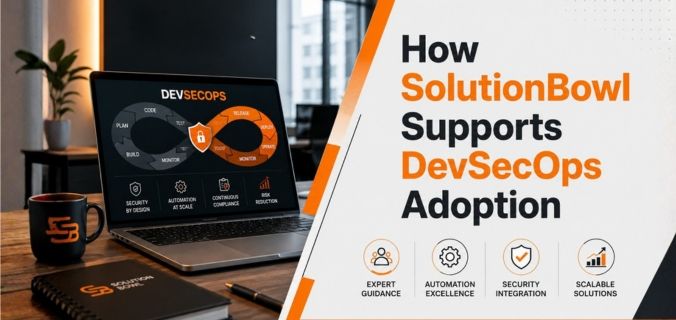
At SolutionBowl, our approach to web and app development includes security planning as a default part of architecture discussions, not an add-on. For businesses undergoing digital transformation, we ensure that security practices scale alongside new systems and integrations. Our DevSecOps consulting engagements typically cover:
- Current state assessment of your development pipeline and security posture
- CI/CD pipeline security integration across your existing toolchain
- Container and Kubernetes hardening for cloud-native architectures
- VAPT planning and remediation support
- Developer enablement so your internal team can sustain the practices after engagement
We work with startups preparing for enterprise sales, mid-sized product companies expanding into regulated sectors, and businesses that need to ensure security keeps pace with growth.
Key Takeaways
- DevSecOps embeds security into every stage of software development rather than treating it as a final checkpoint
- The shift left approach catches vulnerabilities early, when they are cheapest to fix
- Indian businesses face specific pressures from DPDP compliance, API-heavy integrations, and rising breach costs
- DevSecOps is not a single tool. It is a pipeline practice that includes SAST, DAST, SCA, container security, and secrets management
- You do not need a dedicated security team to get started. Automation covers most of the early ground
- The right time to implement DevSecOps is before scaling, not after a breach
CONCLUSION
Building your product on a foundation that can scale safely is not a luxury. It is a strategic decision that pays off every time you do not have to explain a breach to your customers. If you are planning to scale in 2026 and want to assess where your current pipeline stands, talk to the SolutionBowl team. We will help you identify the gaps and build a practical path forward.