 Solution Bowl
Cybersecurity for Small Businesses in India: Threats, Tools & Compliance Guide (2026)
Most small business owners in India assume that cybercriminals are only interested in large corporations. Banks, MNCs, government systems. Not a 30-person trading firm in Gurugram or a bootstrapped D2C brand in Bengaluru.
That assumption is exactly what makes small businesses the easiest target.
According to CERT-In, MSMEs and small businesses now account for a growing share of reported cyber incidents in India. The reasons are straightforward: limited IT budgets, no dedicated security team, and the false comfort of thinking nobody is watching. Cybercriminals know this. They have automated tools that scan thousands of businesses at once, looking for the weakest door.
This guide breaks down the real threats facing Indian small businesses in 2026, the tools that actually work without requiring an enterprise budget, and what you need to know about compliance — specifically around the Digital Personal Data Protection Act (DPDPA).
If you run a business with anywhere between 5 and 500 employees and you operate online in any capacity, this is for you.
Ready to secure your business before a breach happens? Talk to our IT consulting team at SolutionBowl.
Why Cybersecurity for Small Businesses in India Is No Longer Optional
A few years ago, cybersecurity was largely treated as a checkbox item for large enterprises. You put up a firewall, got an antivirus subscription, and called it done.
That equation has completely changed.
Digital payments have become the backbone of Indian commerce. A shopkeeper in Lajpat Nagar accepts UPI. A manufacturer in Faridabad uses cloud-based ERP. A recruitment agency in Noida stores candidate data on Google Drive and communicates entirely over WhatsApp Business. Every one of these businesses has a digital footprint, and every digital footprint is a potential entry point for an attack.
What makes small businesses especially vulnerable:
- No dedicated IT or security personnel on the team
- Shared passwords across multiple accounts and platforms
- Outdated software and unpatched systems running for months
- Heavy reliance on WhatsApp and personal email for business communication
- Little to no employee training on recognising cyber threats
- No backup or recovery plan in place
The financial impact of a cyber attack on a small business is often irreversible. Unlike large enterprises with incident response teams and cyber insurance budgets, a small business hit by ransomware or a data breach rarely bounces back fully. Clients lose trust. Operations stall. Recovery costs can run into the lakhs — sometimes into the crores.
The time to think about this is before it happens, not after.
Already using a cloud ERP or business software? Read our guide on How to Secure Your Business Software and Cloud Tools to make sure your stack isn't your weakest link.
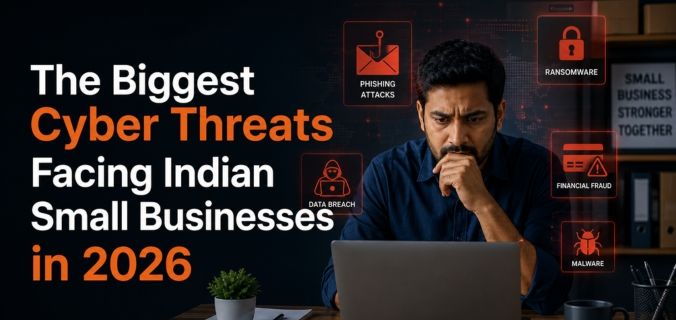
The Biggest Cyber Threats Facing Indian Small Businesses in 2026
Phishing Attacks on Indian Businesses
Phishing remains the most common way cyberattacks begin. An employee receives what appears to be a legitimate email from their bank, a government department, or even their own CEO. They click a link, enter credentials, and within minutes, an attacker has access to company accounts, email inboxes, or financial systems.
Phishing attacks on Indian businesses have become significantly more sophisticated. Attackers now:
- Use regional languages to make messages feel authentic
- Mimic government portals like the GST filing website or the Income Tax portal
- Spoof email addresses that look nearly identical to real ones
- Send fake invoice requests disguised as messages from regular vendors
The risk is not just financial. A single successful phishing attempt can expose customer data, leading to both reputational damage and regulatory liability under the DPDPA.
Ransomware Attacks on Small Businesses in India
Ransomware is the kind of attack that shuts a business down entirely. An employee unknowingly downloads a malicious file, the malware spreads across the network, encrypts all files, and a message appears demanding payment in cryptocurrency in exchange for decryption.
In 2024 and early 2025, ransomware attacks on small businesses in India spiked significantly, particularly in:
- Manufacturing and industrial supply chains
- Logistics and freight management companies
- Healthcare clinics and diagnostic labs
- Retail businesses with large customer databases
CERT-In issued multiple advisories warning of ransomware variants specifically targeting Indian SMEs through unpatched software and weak remote access configurations. The average ransom demand ranges from a few lakh to several crore rupees. And paying the ransom does not guarantee you get your data back.
Cyber Attacks on MSMEs Through Third-Party Access
Many cyber attacks on MSMEs in India do not happen through the front door. They come in through a vendor, a contractor, or a software tool with weak security configurations. A small manufacturer in Pune that supplies to a larger company may not realise that the portal they use to share order data has not been updated in two years. Attackers target this gap deliberately — they know that the big company has enterprise security, but its supplier probably does not.
UPI Fraud Targeting Small Businesses
UPI fraud targeting small businesses causes real damage every day. Common scenarios include:
- Fake collect requests disguised as incoming payments
- QR code tampering at physical points of sale
- OTP phishing calls impersonating bank officials or Razorpay support teams
- Screen-sharing scams where fraudsters pose as payment gateway helpdesk agents
Businesses that operate on thin margins and high daily UPI volumes are particularly exposed because a fraudulent debit may go unnoticed for days.
WhatsApp Business Scams
WhatsApp Business scam attacks have become a serious threat for Indian SMEs. Fraudsters impersonate vendors, clients, or even company leadership. A common scenario: an employee receives a message from what appears to be the owner's number asking them to urgently transfer funds or share login credentials. The number looks legitimate because the attacker cloned the profile photo and display name. By the time the fraud is identified, the transfer is already done.
Businesses that conduct approvals, vendor communications, and financial decisions over WhatsApp are especially exposed because there is no formal verification chain built into the platform.
"Most small businesses in India think they are too small to be noticed by cybercriminals. The reality is the opposite. Automated attack tools do not discriminate by company size. Every unprotected device, every reused password, every unpatched system is an open door."
Best Cybersecurity Tools for Small Businesses in India
Strong cybersecurity does not require a large IT budget. A layered approach using the right tools — many of which are affordable or free — can dramatically reduce your exposure.
Antivirus for Small Business Use in India
- Quick Heal Total Security for Business — India-based company with local support, GST billing, and configurations built for small office environments
- Kaspersky Small Office Security — solid threat detection with a simple central management console, easy to manage without a dedicated IT person
- Bitdefender GravityZone — lightweight on system performance, strong malware detection, available at affordable per-device pricing
Endpoint Security for SMEs
- Microsoft Defender for Business — if your team already uses Microsoft 365, this is included at a very low additional cost and covers real-time threat detection and device management
- Sophos Intercept X for Small Business — covers Windows, Android, and iOS devices in one console; a strong choice for businesses with a mixed device environment
- Malwarebytes for Teams — lightweight, affordable, and easy to deploy without technical expertise
Password Management
- Bitwarden — free for small teams, open source, allows secure credential sharing without sending passwords over WhatsApp
- 1Password — paid but affordable, intuitive UI, good for teams that are not technically inclined
Two-Factor Authentication
Every critical account — banking portals, GST login, cloud storage, and email — should have two-factor authentication enabled. It is free, takes minutes to set up, and blocks the large majority of account takeover attempts even when an attacker already has your password.
- Google Authenticator
- Microsoft Authenticator
VPN for Remote and Hybrid Teams
- NordLayer — business edition of NordVPN, straightforward to set up for small teams
- Perimeter 81 — slightly more feature-rich, good for businesses with multiple remote employees
Email Security
- Zoho Mail with built-in filtering — familiar to businesses already using Zoho CRM or Zoho Books; good spam and phishing controls
- Proofpoint Essentials — stronger enterprise-grade filtering for businesses handling sensitive client data
Cloud Backup
Ransomware loses most of its power if you maintain clean backups stored separately from your main systems.
- Backblaze for Business — affordable, automatic, continuous backup
- Google Workspace Backup — works seamlessly if your team is on Google Workspace for email and Drive
DPDPA Compliance: What Indian Small Businesses Need to Know

The Digital Personal Data Protection Act (DPDPA), passed in 2023 and progressively being enforced through 2025 and 2026, is India's most significant data protection legislation in decades. For small businesses, the implications are real and immediate.
What Is DPDPA?
The DPDPA regulates how businesses collect, store, process, and share the personal data of Indian citizens. If you collect a customer's name, phone number, email address, or any other personally identifiable information, you are a Data Fiduciary under this law.
Key obligations for small businesses under DPDPA:
- Collect only the data you actually need for a stated, lawful purpose
- Inform individuals clearly about what data you collect and why
- Provide a mechanism for customers to request the deletion of their data
- Report data breaches to the Data Protection Board of India within the notified timeframe
- Ensure third-party vendors who process your data follow the same standards
⚠️ Penalties for non-compliance can run up to Rs 250 crore depending on the nature and scale of the violation.
Practical Steps Toward DPDPA Readiness
You do not need a legal team to get started. These are the actions most small businesses can take on their own:
Audit what personal data your business collects and where it is stored
Update your website's privacy policy to reflect current data practices
Enable access controls on your CRM so only relevant team members can view customer data
Review the data-handling practices of any third-party tools or vendors you use
Set up a simple process for handling customer data deletion requests
DPDPA compliance is not a one-time exercise. It requires ongoing attention as your data practices evolve.
Not sure if your current IT setup is compliant? Check out SolutionBowl's IT Audit & Compliance Services to get a clear picture of where you stand.
CERT-In Reporting Requirements
Beyond DPDPA, CERT-In has issued mandatory incident reporting requirements for all organizations operating in India. Any cybersecurity incident — including ransomware attacks, data breaches, or unauthorized access — must be reported to CERT-In within six hours of detection. This means having a basic incident response process in place so that when something goes wrong, you are not scrambling to figure out what happened.
Building a Basic Cybersecurity Plan for Your Business
You do not need a 50-page policy document. What you need is a short, practical plan that covers the most likely risks.
Map Your Digital Assets
Start by listing every tool, platform, and device your business uses: email accounts and business communication tools, banking portals and payment platforms, CRM, ERP, and cloud storage, laptops, mobile phones, and any shared devices. This inventory is your starting point for understanding where your risk actually lives.
Control Who Has Access to What
Not every employee needs access to every system. Role-based access ensures that a sales executive can use the CRM but cannot access your accounting software. This limits the damage a single compromised account can cause across the entire business.
Train Your Team Regularly
The majority of successful cyber attacks start with a human error. A 60-minute training session covering the following can prevent more incidents than any software purchase:
- How to spot a phishing email or suspicious link
- What to do if they receive a suspicious WhatsApp business scam message
- Why they should never share OTPs, even with someone claiming to be from their bank
- Safe password practices and why password reuse is dangerous
Create a Backup Routine
Set up automatic daily backups of your critical data to a cloud storage service that is separate from your main working environment. This is the single most effective protection against ransomware because it removes the attacker's only point of leverage.
Have a Response Plan Ready
Know in advance what you will do if you are hit by an attack:
- Who is your IT vendor or consultant, and do you have their number saved?
- Do you know how to isolate an infected device from your network?
- Do you know the steps for reporting an incident to CERT-In?
- Where is your most recent clean backup stored?
Having even a basic checklist eliminates panic and significantly reduces the damage when something does go wrong.
Cybersecurity for Small Businesses: Common Questions
Is cybersecurity only relevant for large businesses? No. Small businesses are disproportionately targeted because they typically have weaker defences. Automated scanning tools used by attackers do not distinguish between a 10-person startup and a 10,000-person enterprise.
How much does basic cybersecurity cost for a small business in India? A realistic starting budget for a small business with 10 to 25 employees is approximately Rs 15,000 to Rs 50,000 per year. This covers antivirus licences, a password manager, cloud backup, and email security — significantly less than the average cost of recovering from even a minor cyber incident.
Does DPDPA apply to very small businesses? If your business collects personal data of Indian citizens in any capacity, the DPDPA applies to you. The scale of penalties may vary based on the nature of the violation, but compliance obligations are not limited to large enterprises.
What should I do immediately after a ransomware attack?
Disconnect the affected device from your network immediately
Do not pay the ransom without expert guidance
Contact a cybersecurity professional or your IT consultant
Report the incident to CERT-In within six hours as required
Restore from your most recent clean backup once the threat is contained
Are there Indian cybersecurity providers that work with small businesses? Yes. Quick Heal, Tata Communications, and several managed security service providers in India specifically serve the SME segment. IT consulting firms like SolutionBowl also help small businesses assess their current security posture and implement the right tools and processes without requiring an enterprise-level budget.
Final Thought
Cybersecurity is not a luxury for small businesses in India. Given the pace of digital adoption, the rise in phishing attacks on Indian businesses, the frequency of UPI fraud targeting small businesses, and the compliance requirements under DPDPA, it has become a fundamental operating requirement.
The businesses that build basic security practices today are the ones that avoid a very expensive lesson tomorrow. You do not need a security operations centre. You need to close the obvious gaps, train your people, and have a plan.
Start there.
💡 Protect your business data and stay DPDPA-compliant. Get in touch with SolutionBowl's IT consulting team today.