 Solution Bowl
ERP vs. CRM: What Is the Difference and Which Does Your Business Need?
Key Takeaways
- ERP runs your operations. CRM grows your revenue. They are not the same thing.
- Product business? Start with ERP. Service business? Start with CRM.
- Neither is better. The right one depends on your biggest problem right now.
- Together, ERP and CRM are more powerful than either one alone.
- Start with one. Do it well. Then expand to both.
Your firm is expanding, and your finance department is using three distinct spreadsheet programs, neglecting customer interaction and collecting orders. An individual recommends that you purchase software. Someone recommends ERP. Another recommends CRM. You're even more perplexed than you were before.
Choosing between ERP and CRM is one of the most common technology challenges entrepreneurs encounter. Both claim to streamline your operations, manage your information, and automate your processes. But both address entirely different issues.
This manual provides all the answers. In the end, you'll know precisely what an ERP system entails, what distinguishes it from a CRM program, and which option suits your current requirements.
What Is ERP Software?
Enterprise resource planning is a type of software used to integrate and streamline all internal business operations within a single framework.
You can consider ERP to be the central control panel of your business operations. No need to switch between different software solutions to perform accounting, keep track of inventory, calculate wages, make purchases, etc. Here's an example of that:
The manufacturer utilizes ERP software to monitor inventory levels, plan production, handle payments from suppliers, and compile reports needed to stay compliant.
The retailer implements ERP to monitor and control inventory level in several outlets, automate the creation of purchase orders when there isn't enough stock, and compile financial statements.
The expanding IT service provider employs ERP to manage costs, process employees' hours, run billing cycles, and manage vendors while operating with five separate systems.
So, how would you define ERP software in general? ERP is a powerful tool to increase efficiency and minimize costs, which helps in managing business processes.
What Is CRM Software?
Customer Relationship Management, or CRM, is a system designed to manage everything related to your customers and prospects. It focuses on the front office: sales, marketing, and customer support.
Where ERP looks inward, CRM looks outward.
Here is what CRM handles in real businesses:
A B2B software company uses CRM to track every interaction with a lead, from the first website visit to the final contract signature. Sales reps know exactly where each deal stands without digging through emails.
An e-commerce brand uses CRM to segment customers by purchase history, run targeted email campaigns, and automate follow-ups after abandoned carts.
A financial services firm uses CRM to log every client call, schedule renewal reminders, and ensure no high-value relationship goes unattended.
So what is CRM software, simply put? It is the system that helps your team build better relationships, close more deals, and retain customers longer. It does not manage your inventory or payroll. It manages people and conversations.
Difference Between ERP and CRM
This side-by-side comparison aims to clarify the distinction.
Primary Focus
ERP is designed to manage internal business operations, ensuring that all core processes within the organization run smoothly. In contrast, CRM focuses on customer relationships and sales, helping businesses interact effectively with prospects and existing customers.
Core Function
ERP systems handle essential business functions such as finance, inventory, human resources, and supply chain management. On the other hand, CRM systems are built to manage the sales pipeline, marketing activities, and customer support processes.
Primary Users
ERP is primarily used by finance, operations, HR, and supply chain teams who need access to internal data and workflows. CRM, however, is used by sales, marketing, and customer service teams who focus on managing customer interactions and driving growth.
Data Handled
ERP systems deal with internal data such as financial records, stock levels, and employee information. CRM systems handle customer-related data, including interactions, leads, and communication history.
Business Goal
The main goal of ERP is to reduce costs, improve operational efficiency, and ensure compliance across the organization. CRM aims to increase revenue, enhance customer relationships, and improve customer retention.
Popular Tools
Some widely used ERP tools include SAP S/4HANA, Oracle NetSuite, Microsoft Dynamics 365 Business Central, and Zoho ERP. Popular CRM tools include Salesforce, HubSpot, Zoho CRM, and Microsoft Dynamics 365 Sales.
Cost Range
ERP systems typically require a higher upfront investment and involve complex implementation processes. In comparison, CRM systems usually offer a more affordable entry point and faster deployment.
The core difference between ERP and CRM comes down to this: ERP manages how your business runs internally, while CRM manages how your business connects with the outside world.
ERP gives your finance and operations teams a single source of truth. CRM gives your sales and marketing teams a full picture of every customer relationship.
They are not competing tools. In fact, many businesses eventually use both, integrated, so data flows seamlessly between internal operations and customer-facing teams.
"ERP fixes how your business runs. CRM fixes how your business grows. You cannot afford to confuse the two."
ERP vs CRM for Small Business
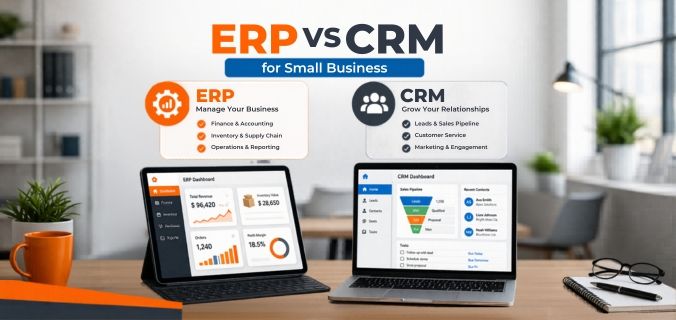
You can't have both systems working together from day one since you own a small business. Therefore, what do you opt for? Your business type and the issues you're facing will largely determine your choice.
If your business deals in tangible products, then your major concerns will be those of stocking, delivery, payment to suppliers, and cash flow. For a business like yours, the best solution would come from getting an ERP system since it manages all your needs effectively.
If your business deals in offering services, then you'll find yourself having challenges in tracking down potential clients, nurturing relationships, and retaining the existing ones. Getting a CRM becomes important here as it makes your sales department run systematically.
For a small business owner trying to decide between the two, here is a general guideline for you. When your processes are not in order, get an ERP first. When your revenues are not growing, choose CRM.
Many modern platforms, such as Zoho and Microsoft Dynamics 365, offer both ERP and CRM capabilities, which makes them attractive for small businesses that want to grow into both without switching platforms. Starting with one module and expanding later is a practical, budget-friendly approach.
Which Is Better: ERP or CRM?
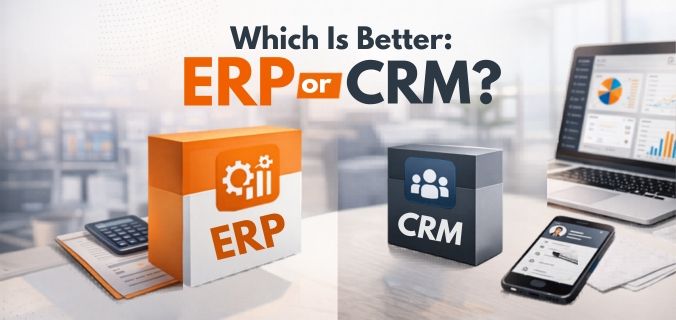
This is the wrong question, but it is worth answering clearly.
Neither system is universally better. Asking which is better, ERP or CRM, is like asking whether a kitchen or a dining room is more important in a restaurant. They serve entirely different purposes, and you need both to run the full operation.
That said, one will deliver more immediate value depending on where your business is today.
If your internal operations are chaotic, invoices are delayed, inventory is constantly wrong, and your finance team cannot close the books on time, ERP will create a more visible impact first.
If your sales pipeline is leaky, your team is losing track of leads, and customer churn is rising, CRM will drive faster results.
The right answer is always, "Which problem is costing you more right now?" Solve that first. Then build toward an integrated system where both tools work together.
Most enterprise businesses eventually run ERP and CRM side by side. The integration between the two is where the real power lives. A sales team that can see a customer's payment history or outstanding invoices directly in the CRM closes deals with far more context and confidence.
"The question is never ERP or CRM. The question is always, "Which problem is costing your business more today?"
ERP vs CRM: Which to Implement First?
This is the practical question that matters most when you are working with a limited budget and team.
When deciding between ERP vs. CRM and which to implement first, use this simple decision framework.
Ask yourself three questions:
- Where is the largest bottleneck? If it is in operations, accounting, or supply chain, go with ERP. If it is in sales, customer retention, or lead management, go with CRM.
- Where are you losing the most money? Operational inefficiency and compliance failures tend to be ERP problems. Lost deals and high churn are CRM problems.
- What stage is your business at? Early-stage businesses with small customer bases and manageable operations often benefit from CRM first because growth is the priority. More established businesses with complex operations benefit from ERP first because efficiency and cost control become critical at scale.
Once you have one system running well, integrating the second becomes far more straightforward. Start focused. Expand deliberately.
Conclusion
Choosing ERP over CRM or vice versa should never become a difficult task. ERP is used to control internal processes. CRM is utilized to manage relations with your customers. Each system is highly useful. However, each solution should be implemented when appropriate.
If there are difficulties in running your operations, ERP will provide you with sufficient control and oversight. CRM can increase revenue and keep customers loyal in the event that sales are not on track. Often, it makes sense to choose the solution that addresses the most time-sensitive issue, implementing both systems gradually.
Are you unsure about which system will be the best option for your company? Our specialists assist Indian small and medium-sized companies and large enterprises in analyzing, deploying, and integrating ERP and CRM software solutions tailored to their requirements and finances.
Explore our ERP and CRM implementation services and get a free consultation today.