
 Solution Bowl
Google Ads for Small Businesses in India: A Practical Guide
If you run a small business in India and you've been thinking about running paid ads, you've probably already Googled something like "how much does Google Ads cost in India for small businesses" and walked away more confused than before. Every answer seems to say "it depends," and nobody tells you what it actually depends on.
This guide fixes that. Whether you're a D2C brand in Jaipur, a SaaS founder in Bangalore, or a coaching institute in Delhi, we'll walk you through everything: what Google Ads for small businesses really costs in India, how to set up your first campaign, what mistakes to avoid, and when it makes sense to bring in professional help.
Why Google Ads Makes Sense for Small Businesses in India
India's digital advertising market crossed ₹60,000 crore in 2025, and a growing share of that spend is coming from small and mid-sized companies. The reason is straightforward: Google Ads puts your business in front of people who are already searching for what you sell.
Unlike social media ads that interrupt users while they scroll, a Google Ads campaign in India targets individuals with active intent. People are prepared to take action when they search for "packers and movers in Hyderabad" or "best accounting software for small businesses." That's the fundamental advantage.
For small businesses operating on tight budgets, this intent-based model is powerful. You're not paying to build awareness among people who may never need your product; you're paying to show up at the exact moment someone needs you.
Here's what makes it especially relevant in the Indian market:
- Low entry barrier. You can start a Google Ads campaign in India with as little as ₹500 per day. There's no minimum contract or mandatory spend.
- Hyper-local targeting. Serve ads only to people within 5 km of your store, or target specific pin codes and cities.
- Measurable results. Every rupee is trackable. You know exactly which keyword, which ad, and which landing page drove each lead or sale.
- Scalability. Start small, test what works, and scale your budget gradually based on real data — not guesswork.
How Much Does Google Ads Cost in India for Small Businesses?
This is the question everyone asks first, and rightfully so. Let's break down the real numbers.
Understanding the CPC Model
Google Ads operates on a cost-per-click (CPC) model for search campaigns. You only pay when someone actually clicks your ad. The cost of each click depends on your industry, the competition for that keyword, your quality score, and your bid strategy.
In India, the average CPC across industries ranges from ₹5 to ₹200+. That's a wide range, so here's a more practical breakdown:
| Industry | Avg. CPC (₹) | Typical Monthly Budget |
|---|---|---|
| Local services (plumbers, tutors) | ₹8 – ₹30 | ₹10,000 – ₹25,000 |
| e-commerce / D2C brands | ₹10 – ₹50 | ₹20,000 – ₹60,000 |
| Real estate | ₹30 – ₹150 | ₹40,000 – ₹1,50,000 |
| Education and coaching | ₹15 – ₹80 | ₹15,000 – ₹50,000 |
| SaaS / B2B software | ₹40 – ₹200 | ₹50,000 – ₹2,00,000 |
| Healthcare & clinics | ₹20 – ₹100 | ₹25,000 – ₹75,000 |
What Affects Google Ads Cost in India?
Several factors directly influence how much you'll actually spend:
- Keyword competition. "Buy running shoes online" costs more per click than "running shoes care tips" because the first one has direct purchase intent. More advertisers bidding on the same keyword drives prices up.
- Quality Score. Google rates your ad relevance, landing page experience, and expected click-through rate on a 1–10 scale. A higher quality score means you pay less per click for the same position. This is where small businesses can compete with bigger spenders by writing more relevant ads and building better landing pages.
- Geographic targeting. Targeting metro cities like Mumbai, Delhi, and Bangalore typically costs more than Tier 2 or Tier 3 cities because of higher competition.
- Time of day and device. CPCs fluctuate based on when your ads run and whether users are on mobile or desktop. For many Indian businesses, mobile traffic accounts for 70–85% of clicks.
- Ad format. Search ads (text-based, appearing in Google results) are priced differently from Display ads (banner-style, shown across websites) and Shopping ads (product listings with images and prices).
A Realistic Budget Framework
If you're just starting, here's a sensible approach to thinking about Google Ads cost in India:
- Testing phase (Month 1–2): Allocate ₹15,000–₹30,000/month. Run 2–3 tightly focused campaigns targeting your highest-intent keywords. The goal isn't profit — it's data collection.
- Optimization phase (Month 3–4): Based on what the data tells you, cut underperforming keywords, double down on winners, and refine your landing pages. Budget stays similar, but efficiency improves.
- Scaling phase (Month 5+): Once you've identified campaigns with positive ROI, gradually increase spend. A well-optimized campaign can comfortably scale to ₹50,000–₹100,000/month while maintaining or improving returns.
Setting Up Your First Google Ads Campaign in India
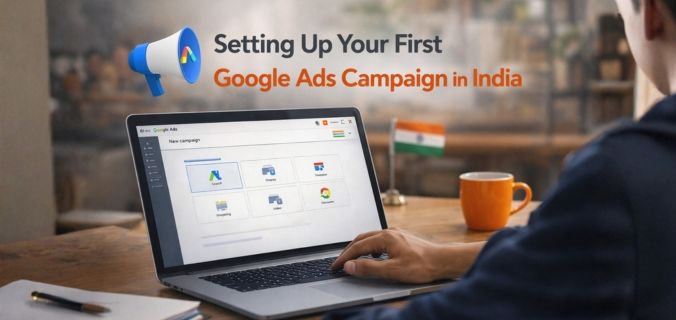
Getting your first campaign live isn't complicated, but doing it right requires a methodical approach. Here's the step-by-step process.
Step 1: Define Your Campaign Goal
Before you touch the Google Ads dashboard, answer one question: What does success look like?
For most small businesses, the goal falls into one of three categories: driving phone calls, generating form submissions, or getting direct purchases. Pick one primary goal per campaign. Trying to optimize for everything simultaneously usually means optimizing for nothing.
Step 2: Keyword Research (The Foundation)
The success of your entire Google Ads campaign in India hinges on the selection of keywords. Here's how to approach it:
- Start with Google Keyword Planner. It's free inside your Google Ads account and shows you search volume, competition level, and estimated CPC for any keyword.
- Think like your customer, not like your business. You might call your product an "enterprise resource planning solution." Your customer is searching for "billing software for a small shop." Use the language your audience uses.
- Focus on long-tail keywords. Instead of bidding on broad, expensive terms like "digital marketing," target specific phrases like "digital marketing agency for restaurants in Pune." These have lower competition, lower cost, and higher conversion rates.
- Use negative keywords from day one. If you sell premium leather bags, add "cheap," "free," "wholesale," and "used" as negative keywords to avoid wasting money on clicks that will never convert.
Step 3: Write Ads That Actually Get Clicked
Responsive Search Ads (RSAs) are the default format for search campaigns. You provide up to 15 headlines and 4 descriptions, and Google tests the combinations to find what performs best.
A few principles that consistently work for Indian small businesses:
- Lead with the benefit, not the feature. "Get 3x More Leads in 30 Days" beats "Advanced Digital Marketing Services."
- Include specific numbers. "Trusted by 300+ Companies" or "Starting at ₹999/month" gives people a reason to click.
- Use a clear call to action. "Book a Free Consultation," "Get Your Quote in 2 Minutes," or "Start Your Free Trial" tell people exactly what to do next.
- Add your location. For local businesses, mentioning your city in the headline ("Best CA Firm in Noida") improves relevance and click-through rate.
Step 4: Build a Proper Landing Page
This stage is where most small businesses lose money. They spend carefully on clicks and then send traffic to their homepage, a page that tries to say everything and convinces no one.
Your landing page should match your ad's promise exactly. If your ad says "Free Website Audit for Small Businesses," the landing page should be about that free website audit. Nothing else.
Key elements of a high-converting landing page: a headline that mirrors the ad, a clear explanation of the offer, social proof (reviews, client logos, and numbers), a single prominent call to action, and rapid load speed, especially on mobile. In India, where a significant portion of users are on 4G connections with variable speeds, page load time directly affects your conversion rate and your quality score.
Step 5: Set Up Conversion Tracking
If you fail to track conversions, you risk losing valuable insights. Set up Google Ads conversion tracking for every action that matters to your business, from form submissions, phone calls, purchases, and WhatsApp clicks.
Without this data, you cannot determine which keywords generate revenue and which merely consume budget. And you can't make informed decisions about where to increase or decrease spending.
Common Mistakes Small Businesses Make with Google Ads
After working with hundreds of businesses across India, here are the patterns we see repeatedly:
- Running ads without conversion tracking. This error is the single most expensive mistake. Without tracking, you might keep funding a keyword that gets many clicks but zero conversions, and you'd never know.
- Targeting too broadly. A coaching institute in Lucknow doesn't need to show ads across all of India. Tighten your geographic targeting to where your actual customers are. The same applies to keywords — broader isn't better.
- Ignoring mobile experience. If 80% of your clicks come from mobile and your landing page takes 8 seconds to load on a phone, you're paying for clicks that bounce before the page even finishes loading.
- Setting and forgetting. A Google Ads campaign in India isn't a "launch and leave" channel. Keywords that work today might become too expensive next month. Competitors enter and exit. Seasonal trends shift demand. Regular monitoring and adjustment are non-negotiable.
- Sending all traffic to the homepage. We covered this topic above, but it's worth repeating. Create dedicated landing pages for each campaign or ad group. The effort is small compared to the improvement in conversion rates.
- Not using ad extensions. Sitelinks, callouts, structured snippets, call extensions, and location extensions take up more space in search results and give users more reasons to click. They're free to add and almost always improve performance.
Google Ads Management in India: DIY vs. Professional Help
At some point, every small business owner faces this question: Should I manage my campaigns myself or hire someone?
When DIY Makes Sense
If your monthly budget is under ₹20,000 and you're targeting a single city with a handful of keywords, managing Google Ads yourself is entirely feasible. Small businesses can benefit from Google's Smart Campaigns feature, which manages bidding, targeting, and ad creation with minimal input.
The trade-off is control. Smart Campaigns simplify things by removing most of the levers you can pull. That's fine when budgets are small, but it limits your ability to optimize as you scale.
When to Consider Professional Google Ads Management in India
Professional management becomes valuable when:
- Your monthly spend exceeds ₹30,000–₹50,000, and you can't afford to waste budget on learning curves
- You're running campaigns across multiple cities, languages, or product lines
- Your industry has high CPCs, and you need advanced bidding strategies to stay competitive
- You've been running campaigns for a few months, and results have plateaued
- You need to integrate Google Ads data with your CRM, analytics, or sales pipeline
What Good Management Looks Like
If you're evaluating agencies or freelancers for Google Ads management in India, here's what to look for:
Transparency. You should have full access to your Google Ads account at all times. Never work with someone who runs campaigns in their own account; your data and campaign history are yours.
Regular reporting with context. Provide weekly or biweekly reports that clarify the numbers and outline the actions taken in response.
Strategic input, not just execution. Good management isn't just adjusting bids. It includes landing page recommendations, audience insights, competitor analysis, and alignment with your broader business goals.
Proven results in your industry. Ask for case studies or references from businesses similar to yours. Managing ads for a SaaS company is very different from managing them for a local restaurant chain.
Advanced Tips to Maximise Your Google Ads ROI
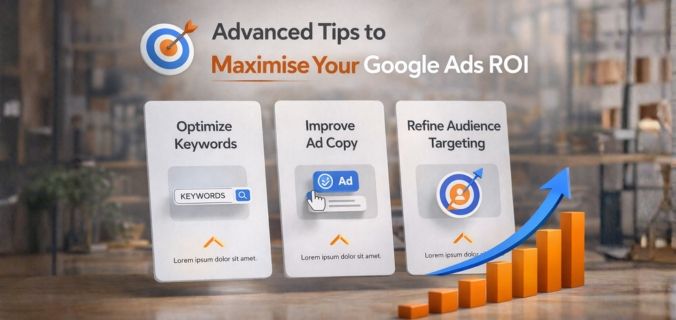
Once you've got the basics running, these strategies can meaningfully improve your returns.
Leverage Audience Layering
Layer demographic and interest-based audiences on top of your keyword targeting. For example, if you sell premium kitchen appliances, you can bid higher for users Google has identified as "homeowners" or people in the top 30% income bracket. This doesn't restrict your reach; it lets you adjust bids based on how likely someone is to convert.
Use Remarketing Aggressively
Someone who visited your pricing page but didn't convert is far more likely to buy than a cold searcher. Set up remarketing lists and run targeted Display or Search campaigns to bring these visitors back. Remarketing CPCs in India are typically 30–50% lower than standard search CPCs, and conversion rates are significantly higher.
Experiment with Performance Max
Performance Max campaigns use Google's AI to run ads across Search, Display, YouTube, Gmail, and Maps simultaneously. For eCommerce businesses with product feeds, this approach can be particularly effective. The trade-off is less control over individual placements, but for small businesses without the time to manage multiple campaign types, it's a practical option.
Optimise for Offline Conversions
Many Indian small businesses, clinics, real estate agents, and consultancies generate leads online but close sales offline. If you're using a CRM, you can import offline conversion data back into Google Ads to tell the algorithm which leads actually became customers. This lets Google optimize for revenue, not just clicks or form fills.
Test Vernacular Ads
India isn't a single-language market. Depending on your target region, running ads in Hindi, Tamil, Bengali, Marathi, or other regional languages can significantly reduce CPCs and improve click-through rates. Competition for vernacular keywords is often a fraction of what it is for English equivalents, and the intent is equally strong.
Is Google Ads Worth It for Your Small Business?
The honest answer is that Google Ads for small businesses works extremely well when done correctly. The Indian market offers a unique combination of high search volume, relatively affordable CPCs compared to Western markets, and a massive base of mobile-first users actively searching for products and services.
But it's not a magic switch. Results come from disciplined keyword research, continuous optimization, strong landing pages, and accurate conversion tracking. Businesses that treat Google Ads as an ongoing system, not a one-time experiment, consistently see positive returns.
If you're spending ₹15,000–₹30,000/month and generating even 10–15 qualified leads, the math works out for most service businesses. For e-commerce, the benchmark is typically a 3–5x return on ad spend within the first 3–6 months of optimization.
Ready to Launch Your First Campaign?
Getting Google Ads right from day one saves you months of wasted spend and frustration. Whether you need help setting up your first campaign, fixing one that's underperforming, or scaling a successful one, our team has helped 300+ businesses across 10+ countries build paid acquisition systems that actually deliver.
We'll review your business, audit your current setup (if any), and give you a clear roadmap, no obligation, no fluff.