 Solution Bowl
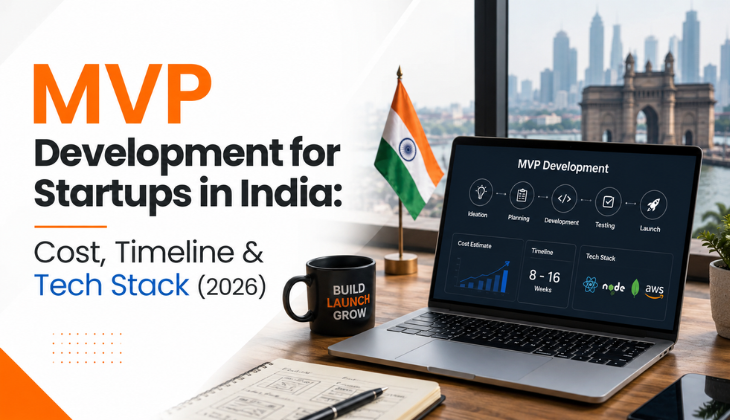
MVP Development for Startups in India: Cost, Timeline & Tech Stack (2026)
You have a product idea. You have a rough sense of what it should do. What you do not have is months of runway to burn on something that might not work.
That is exactly where MVP development comes in.
As 2026 approaches, Indian startups will realize that spending all of their budget on a product nobody has ever tested is becoming increasingly risky. Whether it is Bangalore, Gurgaon, Pune, or Hyderabad where you are building your startup, the concept of minimum viable product development seems to be the most efficient path toward creating a product.
This article sheds light on the MVP development cost in India and the time required for such project implementation and preferred tech stacks, as well as mistakes entrepreneurs tend to make.
What Is an MVP and Why Does It Matter for Indian Startups
A Minimum Viable Product, or MVP, is defined as a product containing the minimum number of features to test the core functionality and validate your business idea among early adopters. It is NOT an abstract idea; it is a working solution that allows proving its value proposition.
The objective is NOT to release some half-finished app into the wild. It is to create a product that is capable of answering a certain question or solving a problem of the target audience efficiently.
MVP development helps Indian startups validate their ideas and attract necessary investments.
Indian founders who raise their pre-seed or seed rounds are increasingly expected to show a working product. An MVP gives you that proof point without the price tag of a full build.
Key Takeaway: An MVP is not a shortcut. It is a smarter way to spend limited resources on learning what actually works.
How MVP Development Differs from Full Product Development
Whereas a full product seeks to cover all scenarios on day one, an MVP will deliver to one specific user scenario in the best way possible.
It comes out clearly when looking at how the two projects are scoped. While full product development tends to take much time through discovery processes, architecture design, several integrations, and thorough quality assurance, the MVP follows a narrow feature set, quick decisions, and clear criteria of success after launch.
Practically speaking, this means that your development team does not waste their time implementing any feature that might come in handy. Instead, they implement only what is necessary for you to validate.
This is easier said than done. Entrepreneurs find it hard to cut off unnecessary features. The role of the right development partner is to ensure that you keep scoping under control.
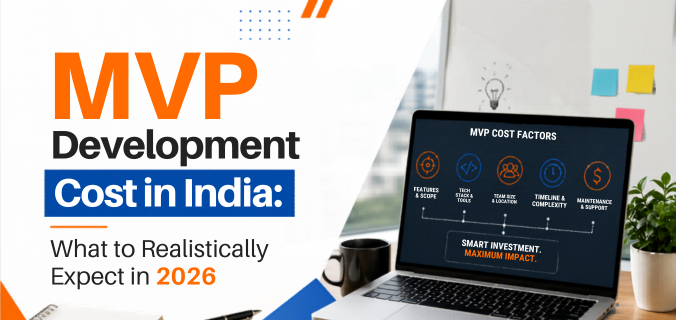
MVP Development Cost in India: What to Realistically Expect in 2026
One of the most searched questions Indian startup founders type into Google is "how much does MVP development cost in India?" The honest answer is: it depends on scope, and anyone who gives you a number before understanding your product is guessing.
That said, here are realistic cost ranges for common MVP categories in 2026:
| MVP type | What's included | Cost (INR) | Timeline |
|---|---|---|---|
| Simple web application | User authentication, a basic dashboard, and one or two core workflows | ₹3,00,000 – ₹8,00,000 | 6 – 10 weeks |
| Mobile app (Android or iOS) | One primary use case with payment integration via Razorpay or similar | ₹5,00,000 – ₹15,00,000 | 8 – 14 weeks |
| Marketplace / two-sided platform | Connecting buyers and sellers with transaction logic and verification flows | ₹10,00,000 – ₹25,00,000+ | 12 – 20 weeks |
| SaaS product | Subscription billing, user roles, and a focused core feature set | ₹8,00,000 – ₹20,00,000 | 10 – 16 weeks |
These ranges reflect working with a professional development agency in India. Freelancer costs can be lower upfront but often carry higher risk in delivery quality, communication consistency, and post-launch support.
What Drives MVP Development Costs Up
Several factors push costs beyond the base range. Understanding them helps you scope intelligently.
Third-party integrations add time. Connecting your MVP to a payment gateway, logistics API, WhatsApp Business API, or GST compliance tool each requires dedicated development and testing. Budget these separately.
Custom UI and UX design increases both cost and timeline but often meaningfully improves user adoption. A generic interface might save ₹1,00,000 in development but cost far more in user drop-off.
AI or ML features are no longer exotic in 2026, but they do add complexity. If your MVP uses AI based recommendations, smart categorisation, or natural language processing, factor in additional time for model integration and testing.
Multiple user roles increase the scope of every feature. A platform serving a buyer, a seller, and an admin has three different permission layers, three different dashboards, and three times the edge cases to test.
Regulatory and compliance requirements, particularly relevant for fintech, healthtech, and edtech startups, require additional architecture decisions around data storage, user consent flows, and audit trails.
"The biggest cost mistake founders make is treating the MVP as a one-time expense. The real investment starts after you launch, when you have actual users telling you what to fix."
MVP Development Timeline in India: Phases and What Each One Covers
Most founders underestimate how much time is spent before a single line of code is written. Here is how a typical MVP engagement unfolds.
Discovery and Scoping | 1 to 2 Weeks
This phase involves understanding your business model, defining your target user, mapping the core user journey, and deciding exactly which features make it into the MVP and which do not. A good development team pushes back on scope during this phase, not after.
Design and Prototyping | 1 to 3 Weeks
Wireframes and UI designs are created, reviewed, and approved before development begins. For many Indian startup clients, this is the phase where they first see their product take shape visually. Rushing this phase almost always causes rework during development.
Development | 4 to 12 Weeks
Backend and frontend work runs in parallel. Most modern teams use agile sprints, typically two weeks each, with regular check-ins and working software demonstrated at each sprint end. This is where the actual build happens.
Quality Assurance and Testing | 1 to 2 Weeks
Functional testing, device testing (especially important for mobile MVPs targeting Android users in India), performance testing, and bug fixing. Do not skip this phase. An MVP that crashes on first use is worse than no MVP at all.
Launch and Handover | 1 Week
Deployment to production, app store submission for mobile, documentation, and handover of credentials and codebase. A good agency also provides a brief post-launch support window.
"Indian startup founders often want to skip the discovery phase because they feel they already know what they want. In my experience, the founders who slow down to scope properly ship faster and spend less."
Choosing the Right Tech Stack for Your MVP
The tech stack you choose affects development speed, long-term scalability, talent availability for future hiring, and ongoing maintenance costs. For Indian startups, where you may need to hire locally or hand the codebase to an in-house team later, choosing widely available technologies is a practical advantage.
Frontend and Web Applications
React.js on the frontend and Node.js or Python (Django / FastAPI) on the backend remain the most popular choices in 2026. They are fast to build with, well-documented, and supported by a large developer community across Indian cities.
Mobile App Development
React Native and Flutter continue to dominate for cross-platform MVP builds. React Native is JavaScript-based and works well if your team already knows web development. Flutter offers superior UI consistency across Android and iOS. For most Indian startup MVPs where budget is a constraint, cross-platform development is the practical choice over building separate native apps.
Databases
PostgreSQL is the default recommendation for relational data. MongoDB works well for flexible or document-based data structures. For startups already using Zoho or similar tools, choosing compatible APIs at the MVP stage saves migration headaches later.
Cloud Infrastructure
AWS, Google Cloud, and Microsoft Azure all have strong presences in India. Many Indian startups default to AWS for its mature ecosystem and local region availability.
AI-Enabled MVPs
If your MVP has AI components, Python is almost always the backend language of choice given the depth of its ML and data science libraries.
Want to explore the right tech stack for your product idea? Read our guide on web and app development to understand how modern platforms are architected for growth: Web and App Development for Indian Businesses
What Indian Startup Founders Get Wrong About MVP Development
Experience working with Indian tech startups reveals a few consistent patterns that slow projects down or push costs up unnecessarily.
Treating the MVP as the final product is the most common mistake. An MVP is a learning tool. The moment you try to make it production perfect before launch, you have lost the point. Ship, learn, and iterate.
Choosing a development partner based only on price is another trap. The cheapest quote rarely accounts for the full scope. A detailed proposal from a credible agency that asks hard questions about your business model is almost always worth more than a low number from someone who agreed to everything on the first call.
Skipping user research before development costs founders dearly. If you do not understand your user's actual pain point, your MVP will be built on assumptions that real users will quickly disprove. One week of user interviews before development saves months of rework afterward.
Trying to build for every use case on day one kills timelines and budgets. Prioritise ruthlessly. Everything else is version two.
Ignoring post-launch growth planning is also common. Your MVP launch is not the end. It is the beginning. Think about how you will drive initial users, collect feedback, and fund the next iteration before you ship version one.
If you are planning to drive traffic and users to your MVP after launch, SolutionBowl's performance marketing services can help you build that funnel from day one: Performance Marketing for Startups
How to Choose the Right MVP Development Partner in India

India has thousands of development agencies and freelancers offering MVP services. Here is what separates a reliable partner from a risky one.
Look for domain experience in your product category. A fintech MVP is different from a logistics MVP. Domain familiarity reduces the time spent explaining your market to developers.
Ask to see a real portfolio of shipped products, not design mockups. Agencies that can show you live products they have built carry far less execution risk.
Evaluate communication quality before you sign anything. How fast do they respond? How clearly do they explain technical decisions? How honest are they about what is not possible within your budget? Communication problems during development are expensive.
Ask about post-launch support explicitly. What happens if there is a critical bug two weeks after launch? Is that covered in your contract? What is their SLA?
Look for a partner who pushes back on your scope. Counterintuitively, a team that says "this feature should wait for version two" is often more valuable than one that says yes to everything. Agreeing to build everything is easy. Building the right things is hard.
"The best development partners act like co-founders during the MVP phase. They help you figure out what to build, not just how to build it."
If you are evaluating a mobile app MVP specifically, our in-depth guide covers everything from platform choices to cost benchmarks: Custom Mobile App Development Services
When to Move Beyond the MVP: Custom Software and ERP
An MVP gets your product to market. But once you have validated demand and started scaling, the infrastructure needs of your business grow fast.
Many Indian startups that launch successfully soon face operational chaos: orders managed over WhatsApp groups, finances tracked in Excel, and team workflows handled through disconnected tools. This is where custom business software and ERP systems start to matter.
If you are scaling operations across inventory, finance, HR, or supply chain, an ERP built specifically for your business model delivers far more value than stitching together disconnected SaaS tools. For Indian SMEs and growing startups, a right-sized ERP solution brings the same operational control that large enterprises enjoy, at a fraction of the enterprise software cost.
Explore how SolutionBowl builds custom ERP systems for Indian businesses: ERP Software Development India
Is Your MVP Idea Ready to Build?
Building an MVP in India in 2026 is genuinely achievable for most startups with a clear idea, a realistic budget, and the right partner. The Indian tech ecosystem has the talent, the infrastructure, and the market depth to support ambitious product ideas across nearly every vertical.
The founders who succeed are not those with the most money. They are the ones who move fast, stay focused, and learn relentlessly from every user interaction after launch.
If you have a product idea and want to understand what it would realistically take to bring it to market, talk to the SolutionBowl team. We will help you define the right scope, choose the right tech stack, and build something your users actually want.
👉 Get in Touch with SolutionBowl