 Solution Bowl
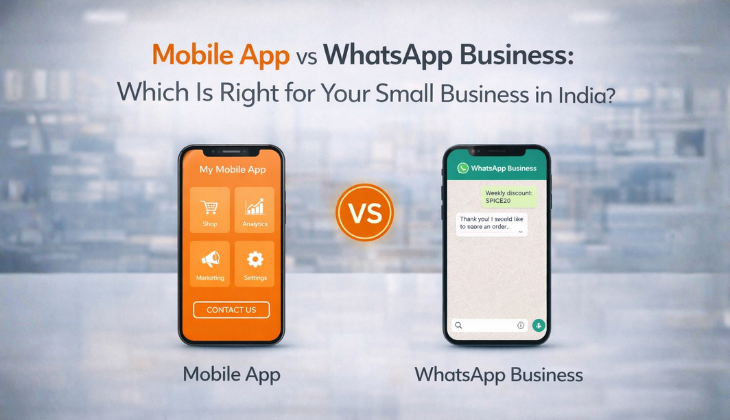
Mobile App vs WhatsApp Business: Which Is Right for Your Small Business in India?
Picture this. You run a boutique clothing store in Lajpat Nagar. Your regulars ping you on WhatsApp for updates on new stock. You manage orders through a catalogue. Things work until they don't. Messages pile up, you miss inquiries at night, and a customer who ordered twice never comes back because there was no way to remind them about a sale.
At this point, most Indian small business owners start asking the same question: Do I actually need a proper mobile app, or is WhatsApp Business enough?
It is a fair question. Both tools help you stay connected with customers. Both are built for mobile-first India. But they serve very different stages of a business, and choosing the wrong one at the wrong time either wastes money or quietly limits your growth.
This guide breaks down exactly when WhatsApp Business works, when a custom mobile app makes more sense, and how to make that call for your specific business.
Why This Decision Matters More in India Than Anywhere Else
India is not just a big market; it is a WhatsApp-first market. With over 500 million active users, WhatsApp is the default communication channel for everything from family groups to business inquiries. When Meta launched WhatsApp Business in 2018, millions of Indian shopkeepers, freelancers, and service providers adopted it almost overnight. It was free, familiar, and required zero technical knowledge.
At the same time, India's smartphone penetration is now deep enough that a branded mobile app is no longer just for Swiggy and Myntra. Local businesses, such as salons, coaching centres, pharmacies, clothing stores, and travel agents, are building their own apps and using them to build customer loyalty in ways WhatsApp simply cannot.
So the question is not really "which is better." The question is, which is right for where your business is right now?
What WhatsApp Business Actually Gives You (and Where It Stops)
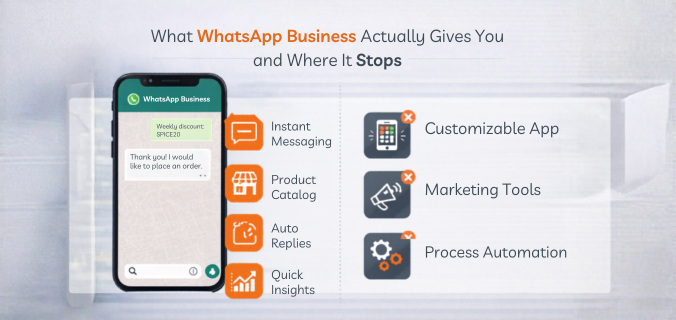
WhatsApp Business is excellent at what it was designed to do: help a small, owner-run business communicate with customers in a personal, frictionless way.
The free app lets you create a verified business profile with your hours, address, and website. You can set up a product catalog, send automated greeting messages, and use quick replies to respond to common questions faster. For a shop owner handling 20 to 50 customer conversations a day, this is genuinely useful.
Where it works well:
- Early-stage businesses are still finding their customer base
- Service businesses where relationships are personal and conversational (tutors, tailors, local consultants)
- Businesses in categories where customers already expect WhatsApp communication (catering, gifting, local delivery)
- Owners who handle enquiries personally and do not yet need a team
Where the cracks start to show:
The moment your business grows beyond one or two people managing the phone, WhatsApp Business becomes a liability. The free app is tied to a single device and phone number. There is no proper way to assign conversations to different team members, no automated order tracking, no customer history dashboard, and no loyalty program. Broadcasts are limited to 256 contacts. You cannot send targeted promotions to a segment, say, customers who bought from you in December but not since. And critically, there is no way to send push notifications unless a customer messages you first.
For many growing Indian businesses, the biggest limitation is invisibility. Your WhatsApp catalogue does not appear in Google Search. A customer who downloaded your catalog six months ago has no reason to open WhatsApp and find you again, unless they decide to. A mobile app, by contrast, sits on their home screen.
If you are managing fewer than 50 customer conversations a week and your business is still in early growth mode, WhatsApp Business is not just fine; it is the smart choice. Do not spend on a custom app before you need one.
What a Custom Mobile App Actually Gives You
A branded mobile app is not just a fancier version of WhatsApp. It is a different category of tool entirely, one built around ownership, automation, and long-term customer retention.
When a customer downloads your app, you have a direct, branded channel to reach them. You can send push notifications for new arrivals, flash sales, or appointment reminders. You can build a loyalty program that tracks purchases and rewards repeat buyers. You can offer order tracking, in-app payments via UPI, personalised product recommendations, and a seamless booking or checkout flow, all inside your own brand environment.
Where a mobile app genuinely transforms a business:
- Retail and e-commerce businesses with a growing repeat-customer base
- Restaurants, cloud kitchens, and food businesses managing orders
- Fitness centres, salons, and clinics where appointment booking and reminders drive revenue
- EdTech or coaching businesses where course delivery, attendance, and payments all happen in one place
- Any business where loyalty, repeat purchase, and brand recall are the growth engine
The comparison with WhatsApp Business also changes when you think about data. Your WhatsApp conversations exist inside Meta's platform. A custom mobile app gives you first-party customer data, purchase history, browsing behavior, and preferences that you own, can analyse, and can act on.
For businesses thinking about long-term growth and customer retention, this data ownership is not a nice-to-have. It becomes the foundation of your marketing strategy.
A Direct Comparison: Mobile App vs WhatsApp Business for Indian Businesses
| Feature | WhatsApp Business | Custom Mobile App |
|---|---|---|
| Setup cost | Free | ₹4 lakh – ₹25 lakh+ |
| Time to launch | Hours | 3 to 6 months |
| Team access | Very limited (1 device) | Multiple roles and logins |
| UPI / payment integration | WhatsApp Pay only | Any payment gateway |
| Customer data ownership | Meta owns it | You own it |
| Google Search visibility | No | Yes (via Play Store / App Store) |
| Brand presence on the customer's phone | No dedicated icon | App icon on home screen |
The Real Deciding Factor: Where Is Your Business Right Now?
Here is a practical way to think about it.
Stick with WhatsApp Business if:
- You are handling enquiries personally, and volumes are manageable
- You are still building your initial customer base
- You are not yet doing repeat-order or subscription-based business
- You want to test demand before investing in technology
It is time to think about a custom app if
- You are losing track of orders, follow-ups, or customer conversations
- Customers are asking about their order status repeatedly
- You want to run loyalty or referral programmes
- You are growing a team and need shared access to customer communication
- Repeat purchases and retention are central to your business model
- You want your brand to have a permanent presence on your customers' phones
One thing worth noting: these are not mutually exclusive. Many Indian businesses use WhatsApp Business for real-time customer communication alongside a mobile app for orders, loyalty, and notifications. The two tools complement each other well at a certain stage of growth.
For businesses exploring the WhatsApp Business API, a more powerful, team-friendly version that connects to CRM systems, this guide explains how it works and what it costs: WhatsApp Business API: Complete Guide for Businesses (2026)
What Does a Mobile App Actually Cost for an Indian Small Business?
This is the question that stops most small business owners before they even begin the conversation. The honest answer: it depends heavily on what you want to build.
A basic business app with a product catalogue, push notifications, and UPI payment integration typically starts around ₹4 lakh to ₹8 lakh in India. A more complete app with loyalty programs, order tracking, and an admin dashboard falls between ₹10 lakh and ₹20 lakh. These are not small numbers for a bootstrapped business, which is exactly why timing matters.
If you are doing less than ₹10 lakh in annual revenue, a custom app is probably premature. If you are crossing ₹25 lakh to ₹50 lakh in revenue with a strong repeat-customer base, the app will pay for itself through reduced customer acquisition costs and higher retention within the first year.
The right approach is to start with an MVP, a version of your app with only the core features, rather than trying to build everything at once. This keeps costs manageable and lets you learn what your customers actually use before investing in additional features.
Industries Where Indian Businesses Are Making the Switch
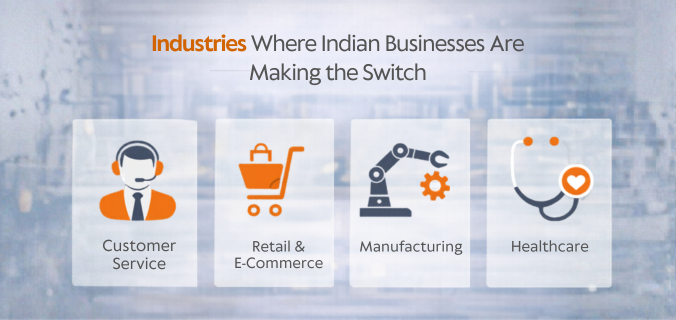
Across India, certain categories have moved decisively toward mobile apps because the business model demands it:
For restaurants and cloud kitchens, order management, table booking, and delivery tracking are nearly impossible to manage well through WhatsApp alone at scale.
Salons and wellness businesses' appointment booking, cancellation management, and package tracking all run smoothly through an app in a way that WhatsApp chat threads simply cannot support.
Coaching and EdTech businesses' course delivery, attendance, assignments, and fee payments in one place reduce administrative burdens dramatically.
Retail and fashion loyalty points, size preferences, wishlist features, and sale notifications create the kind of personalised experience that drives repeat purchases.
Pharmacies and healthcare prescription uploads, refill reminders, and lab report delivery are features that build genuine customer trust and stickiness.
If your business fits any of these categories and you are already at a stage where growth feels constrained by manual processes, a mobile app is worth evaluating seriously.
Making the Right Call for Your Business
The mobile app vs. WhatsApp Business decision is not really a technology decision. It is a business-stage decision.
WhatsApp Business is one of the best free tools available for Indian small businesses in their early years. It is personal, low-friction, and works inside the app your customers are already using every day. Do not abandon it before you have outgrown it.
A custom mobile app is a significant investment, but at the right stage of growth, when retention, automation, and brand ownership become the priority, it changes the trajectory of your business in ways that no messaging app can.
If you are unsure where your business currently sits in this decision, the best starting point is a conversation with a team that has helped businesses across India make exactly this call. Whether you eventually build an app, scale your WhatsApp setup, or combine both, the right advice upfront saves a lot of wasted spend later.
Explore how SolutionBowl has helped Indian businesses build mobile apps that grow with them: How to Choose a Mobile App Development Company in India
SolutionBowl helps Indian businesses at every stage of growth, from WhatsApp Business setup to full-scale custom app development. Talk to our team to find out what the right next step is for your business.